
Logic, reasoning, and proof that feel unfamiliar
Conditional statements and logical arguments can be built up step by step until a proof feels like a sequence of justified claims, not a memory test.
Geometry tutor in Frisco, TX · Grades 9–10
Most Frisco Geometry tutoring focuses on memorizing formulas — area, volume, the Pythagorean theorem — and moves on. Master the Concepts spends more time on the part school often rushes through: logical reasoning and proof. A student who can recite a formula but cannot explain why a triangle congruence theorem holds is the exact profile that struggles once a problem changes shape or combines two ideas at once. We help Frisco students build spatial reasoning and argument alongside formula fluency, connecting transformations, triangles, circles, and coordinate geometry into one coherent way of thinking rather than a list of separate topics to recall.
At a glance
Support starts with the student's current work — not a generic sequence or a one-size-fits-all placement.
Read real parent testimonials →Concept before procedure
A student should be able to justify a geometric claim step by step, not just apply a memorized formula — that connection is what makes an unfamiliar figure or a multi-step proof more manageable, and it's what separates recognizing a shape from actually reasoning about it.
Use the student's current work to identify the concept — not just the question — that is creating friction.
Move among words, diagrams, quantities, graphs, and equations until the relationship is clear.
Use short, deliberate problems that ask the student to choose and explain a method independently.
A useful starting point
A current proof, homework problem, or a description of a recurring sticking point is usually more useful than a broad placement label.
Conditional statements and logical arguments can be built up step by step until a proof feels like a sequence of justified claims, not a memory test.
The work can connect translations, reflections, congruence, and polygon properties so a student sees one set of underlying ideas rather than several disconnected rules.
The work can make the reasoning behind a formula visible so the student can adapt it to an unfamiliar figure instead of relying on recall alone.
Geometry reasoning pathways
Every plan begins with the current classwork and the habits underneath it. These are the connected areas used to make that starting point specific.
Conditional statements, geometric proofs, translations, reflections, rotations, and triangle congruence theorems.
Similar figures, the Pythagorean theorem, trigonometric ratios, and circle theorems including arc length and tangents.
Surface area and volume of solids, composite figures, and the distance, midpoint, and slope tools used in coordinate proofs.
Educator context
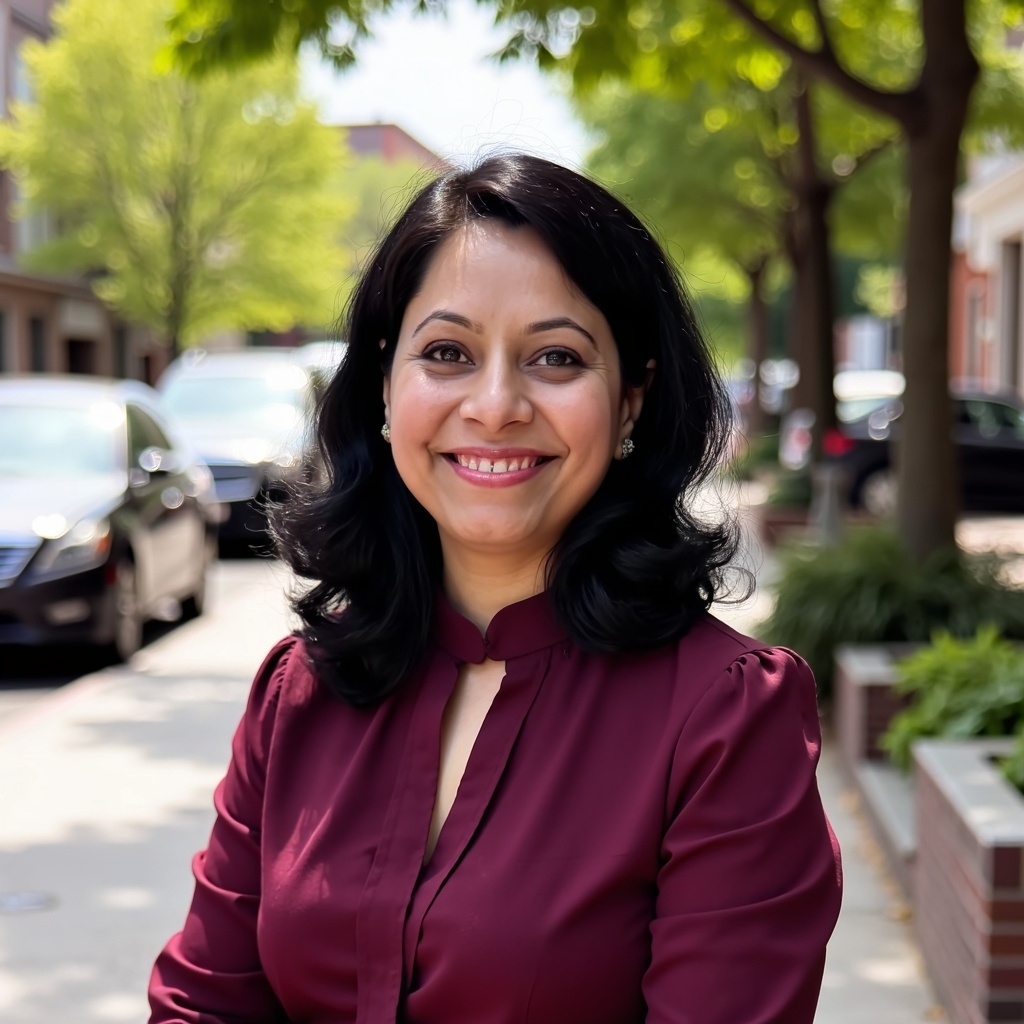
Ms. Neha
B.E. Biomedical Engineering
5+ years of teaching experience
Scientific patent research background
How the tutoring approach works
With a B.E. in Biomedical Engineering, more than five years of teaching experience, and a research background in scientific patents, Ms. Neha uses a student's current Geometry work to identify the logical step or representation that needs attention. Students practice building and explaining an argument, not memorizing a steeper set of formulas for the next unit.
Not sure where to start?
A short skills assessment with Ms. Neha is the fastest way to find the right starting point in Geometry — whether that's an Algebra I foundation, a specific proof concept, or choosing the TEKS or AoPS track.
A short conversation with Ms. Neha to confirm the right starting point — no obligation to enroll.
Keep exploring
Every subject below is live — explore whichever fits your student’s current course.
Connects equations, functions, tables, and graphs into reasoning that carries into the STAAR EOC.
Bridges arithmetic into algebraic reasoning ahead of Algebra I.
A live online group class covering Chemistry, Physics, and Biology fundamentals.
Every North Texas city below has a live math tutoring page — explore whichever is closest to your family.
Serving Prosper ISD families across both Collin and Denton counties.
Built around Plano ISD's multiple secondary math courses and pathways.
Serving McKinney-area families across McKinney, Allen, Frisco, Prosper, Lovejoy, and Melissa ISDs.
Serving both Lewisville ISD and Little Elm ISD families in The Colony.
Serving Little Elm ISD, Frisco ISD, and Denton ISD families depending on address.
A useful next conversation
Schedule a short conversation with Ms. Neha to discuss a recent assessment, the current unit, or a foundational skill that may be making the work feel harder.
Clear before you begin
Common Geometry starting points include logic and proof, transformations, triangle congruence, polygons and quadrilaterals, similarity and right triangles, circles, area and volume, and coordinate geometry.
Equations, functions, and graphing habits from Algebra I can be reviewed before or alongside current Geometry classwork.
Private tutoring follows one student's current materials, pace, and conceptual needs. Group tutoring gives students a shared Geometry focus and opportunities to compare proof strategies and explain reasoning with peers.
Yes. Families can choose a Texas state (TEKS) curriculum track focused on school alignment, or an Art of Problem Solving (AoPS) track with more challenge-based, competition-style problems.
Yes. Recent homework, quizzes, proofs, and unit topics provide useful evidence of the idea that is unclear while keeping the conversation relevant to the student's current course.
No. Geometry is not one of the Texas STAAR End-of-Course subjects, so preparation focuses on school-based assessments and the reasoning skills that carry into later math courses.
Private and group tutoring formats
Master the Concepts offers both a Texas state (TEKS) track and an Art of Problem Solving (AoPS) track for Geometry, in two useful formats for Frisco families.
Private tutoring is useful when a student needs a focused starting point in current Geometry work, an Algebra I foundation, or a specific proof or concept that isn't clicking. The work follows the student's own materials and pace.
Group tutoring is useful when students are ready to explore shared Geometry ideas, compare proof strategies, and articulate why an argument works alongside peers, in either the TEKS or AoPS track.
What it costs: group tutoring runs $120/month for 4 sessions of 90 minutes each; 1:1 coaching runs $200/month for 4 sessions. Exact pricing and the current cohort are confirmed on the program page before enrollment.
For Frisco families
For Texas public-school students, Geometry follows Algebra I in the high school math sequence and is assessed through school-based coursework rather than a STAAR End-of-Course exam. Master the Concepts is an independent tutoring practice supporting TEKS-referenced concept review and public-resource practice; it is not affiliated with TEA, Frisco ISD, or any campus. Families from Fowler Middle, Lawler Middle, Frisco High, Centennial High, Liberty High, Emerson High, and Panther Creek High can bring current materials — course selection, compacted-math pathways, honors or Pre-AP sequencing, placement, and testing logistics should be confirmed directly with a campus counselor.
Exam preparation
Geometry in Texas is not a STAAR End-of-Course subject, so preparation centers on school-based assessments and the reasoning skills that carry forward into Algebra II and beyond. Current course work, tests, and released practice problems can identify what a student needs to explain or represent more clearly.
School planning
Confirm course sequencing, honors or Pre-AP options, placement, and prerequisites with a school counselor.
FISD Course Catalog & Academic Guides ↗Serving families from
Fowler Middle, Lawler Middle, Frisco High, Centennial High, Liberty High, Emerson High, Panther Creek High.
Nearby: Prosper, Plano, McKinney, The Colony, Little Elm.